Trump’s Tax Law Expired Healthcare Credits and Trump’s Tariffs Have Raised Taxes By $850 for Most Latinos While Benefitting the Top 1%
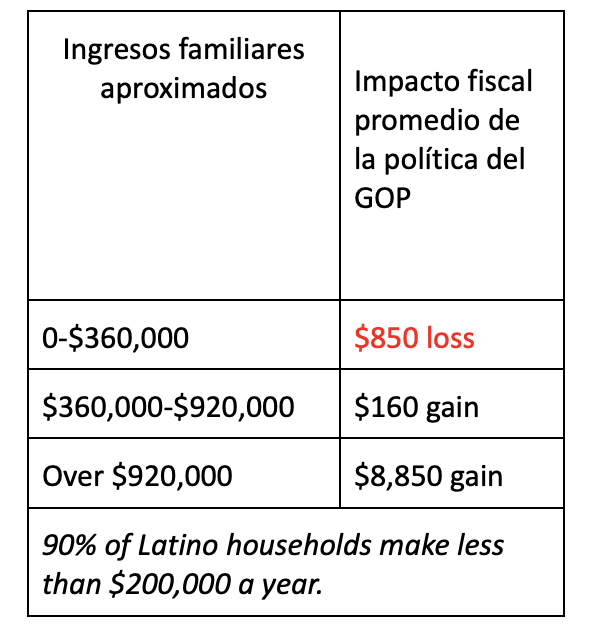
This Tax Day, almost all Latino families are paying $850 more in taxes while the richest 1% of households get a $8,850 tax cut, according to a new analysis from Americans for Tax Fairness (ATF) based on data from the Institute for Taxation and Economic Policy (ITEP). Very few Latino families are in the top 1% so they are hit by last year’s GOP tax-and-spending bill; the expiration of healthcare premium tax credits; and President Trump’s tariffs.
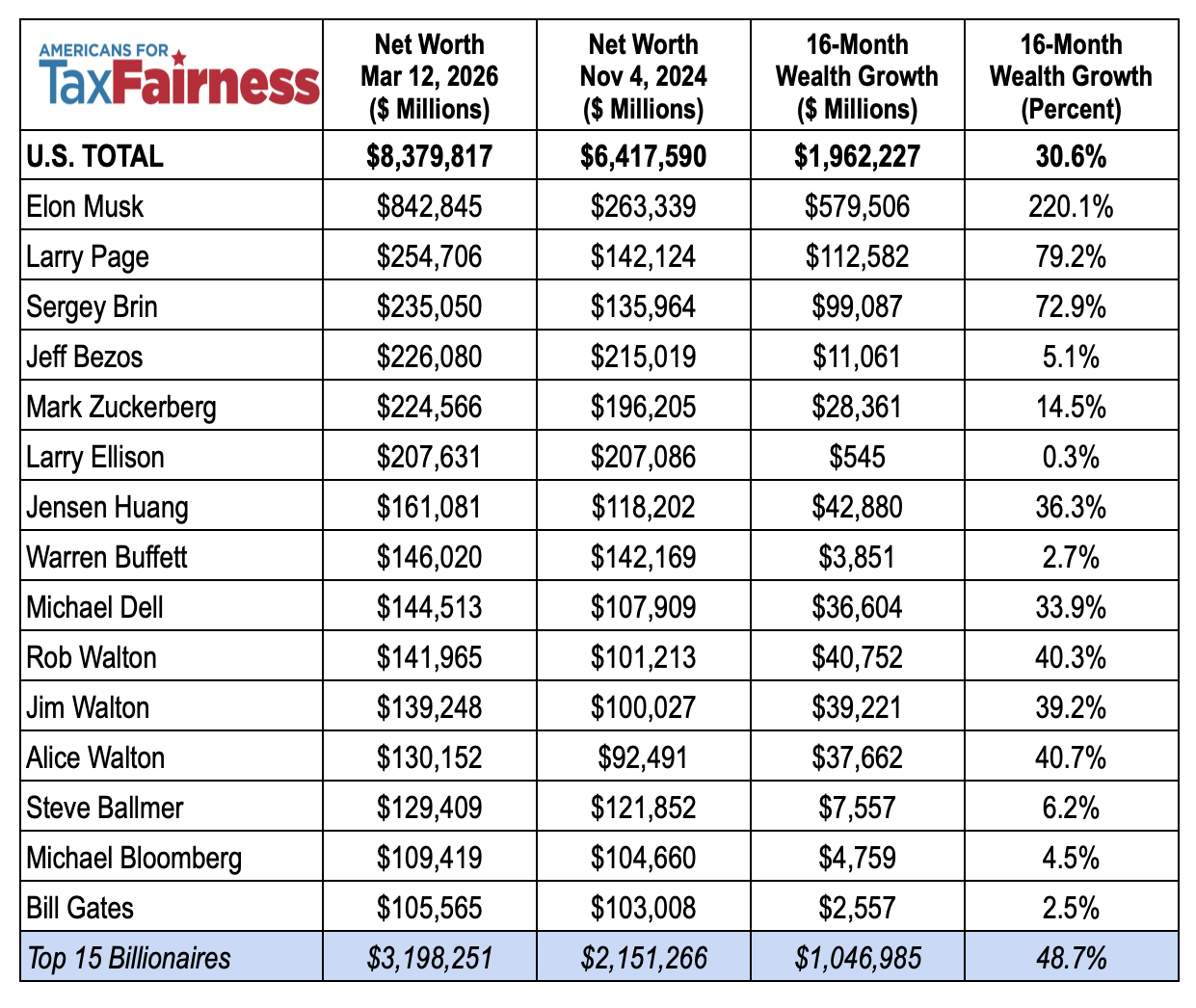
According to ITEP’s findings, in 2026 households with income over roughly $360,000 will net a financial benefit from the three Republican policies. And it’s those with income over about $920,000 who will receive the lion’s share of that benefit. The median income of Latino families in 2024 (the latest year with available data) was about $71,000. Almost 90% had income below $200,000. Among the top 1% deriving the most from the GOP policies are America’s billionaires, who in just the 16 months after Trump was reelected saw their collective fortune grow by almost $2 trillion.
“Republican tax policy is punishing Latino families while boosting billionaire fortunes,” said David Kass, ATF’s executive director. “This Tax Day is a good time to take stock of the disparate impact of Republican fiscal policies–for Latinos, they have on balance meant higher costs for healthcare and other necessities. Meanwhile, billionaires (who are almost all white) have grown trillions of dollars richer, thanks in part to the GOP’s tax giveaways to the wealthy.”
Sources: ITEP; Census Bureau
Source: Americans for Tax Fairness
Last July, Trump and his fellow Republicans enacted H.R. 1, the One Big Beautiful Bill Act, a massive tax-and-spending law that, including added interest on the debt, will cost more than $4 trillion over the next decade. The bulk of that expense comes from $4.5 trillion in tax cuts that mostly benefit the wealthy. The highest-income 20% of American households will receive 70% of the tax cuts in 2026, and the top 1%–those with incomes of roughly a million dollars or more–will receive $1 trillion over the next decade. If temporary components of the law are eventually made permanent, the total cost would increase to $5.5 trillion.
Those tax cuts were partially paid for through cuts to vital human services. Around 15 million people will likely lose healthcare over the next eight years because of cuts to Medicaid and the failure of the law to extend enhanced premium tax credits to buy coverage under the Affordable Care Act. If exclusion from Medicaid is proportional to participation in the program, around three million Latinos could lose coverage. About a million Latinos are at risk of losing ACA coverage because the enhanced premium tax credits were allowed to expire. Some four million people will lose nutrition assistance or see their benefits substantially reduced. As of December 2025, Protect Our Care had counted 600 hospitals, clinics and nursing homes that had closed or were in danger of closing because of the healthcare cuts in the Republican law.
Meanwhile all through the past year, Trump has unilaterally imposed a dizzying array of tariffs on imports from around the world. Carefully crafted tariffs can be one tool for protecting domestic industries and jobs. But Trump’s scattershot approach, targeting both friendly and unfriendly trading partners, has the main impact of raising costs for American families. (Even after the Supreme Court found the basis of many of Trump’s original tariffs unconstitutional, Trump reinstated much of his tariff regime under a different authority.)
The combination of tax and service cuts plus Trump’s tariffs will saddle the lowest-income 80% of Americans–four out of five people–with an average of $793 in higher costs this year, according to an ATF analysis of data from the Institute on Taxation and Economic Policy (ITEP). The same analysis shows the highest-income 1% will each enjoy on average a cumulative savings of $8,850.
TRUMP-GOP FISCAL POLICIES: Those Helped and Those Harmed
This Tax Day, as Americans settle up with the IRS, there’s another calculation to be made, one that identifies the winners and losers from Trump-GOP fiscal policies. Republican choices on taxes, spending and tariffs over the past year have benefited rich households and big corporations while making life less affordable for everyone else. Only bold, comprehensive tax reform can reverse this outcome by ensuring the rich and corporations contribute a fairer share to our national prosperity; while restoring, expanding and improving public services the rest of us rely on to get by and get ahead.
HELPED: Rich Members of Congress
Members of Congress are among the few Americans who can help set their own tax rules. Through their votes, senators and representatives can help lower or raise rates, open or close loopholes, initiate or end special breaks. The wealthier a member of Congress is and the more income he has the greater his personal interest in crafting the tax code.
NOTE: Congressional financial disclosure reports list assets and income in ranges rather than specific amounts. The analysis here is generally based on the upper-range figures. Also, descriptions of assets and income are not standardized across reports so the conclusions drawn here are based on the best possible interpretation of the data. See methodology here.
Rich members who may have benefited from the law they voted for include:
| MEMBER
OF |
ESTIMATED NET WORTH
(3/20/26) |
POTENTIAL ESTATE TAX SAVINGS
(if applied in 2026) |
POSSIBLE PASS-THROUGH TAX SAVINGS |
| Sen. Jim Justice (R-WV) | $664 million | $6 million | $3.7 million |
| Rep. Vern Buchanan (R-FL) | $262 million | $6 million | $962,000 |
| Sen. Ron Johnson (R-WI) | $67 million | $6 million | $148,000 |
| Sen. Rick Scott (R-FL) | $513 million | $6 million | $50,000 |
Source: Americans for Tax Fairness
HELPED: Big Corporations
Even though the main focus of the 2025 Trump-GOP tax-and-spending bill was the permanent extension of individual tax cuts that were scheduled to expire–cuts that heavily favored the wealthy–big corporations also received costly tax handouts.
Bonus Depreciation
According to standard accounting rules, the cost of long-lasting equipment such as machinery and vehicles purchased by a business is supposed to be deducted in equal pieces over time to reflect the slow loss of value. But the new law instead lets firms deduct the full cost of big-ticket purchases in the year acquired. This huge break for business will cost $363 billion in lost revenue over the next decade. The revenue loss from this one tax break is almost double the amount cut from food assistance in the Republican law, a cut that imperils the nutritional health of some four million people.
Huge corporations are among the biggest beneficiaries of this tax loophole. Amazon cut its tax bill by $6.5 billion last year alone thanks to bonus depreciation, Meta (Facebook) by $4.9 billion, and Alphabet (Google) by $3.3 billion.
Research and Experimentation Expensing
For the last several years, companies have been required to deduct over time (amortize) the cost of research and experimentation. This reflects the long-term benefits of much research. The new law allows firms to instead write off the full cost of research in the year incurred. This loophole will lose $141 billion in public revenue over the next decade. That’s nearly enough money to have avoided the cuts to nutritional assistance noted above.
Meta alone last year avoided $12.6 billion in taxes because of R&E expensing.
Looser Interest Deduction Rule
Big companies are allowed to deduct interest when figuring their taxes, though only to the extent it does not exceed 30% of their income. But there are different ways of defining income. For the past few years, firms had been required to use a stricter version of income, one that resulted in a smaller number and therefore a tighter restriction on the interest deduction. The new Republican law changed the income definition to create a bigger number and therefore larger deductions.
Among the biggest beneficiaries of the looser interest-deduction rule are private equity firms. Private equity uses large pools of money invested by rich individuals and other entities to buy up companies, often harshly cut costs, then resell them at a hoped-for profit.
HARMED: Prototypes of Individual Suffering
Many individual victors of the Trump-GOP fiscal system are easy to spot because they’re rich, famous and powerful. In contrast, the suffering of individual victims of those same Republican policies generally occurs out of the public eye. To address this discrepancy, the Progressive Caucus Action Fund (PCAF) has developed prototype profiles of the kind of individuals and families left worse off by the big GOP tax-and-spending bill enacted last year.
Among these proxies for real victims is a 45-year-old waitress named Angela, single mom to two daughters. It’s explained that she makes too little money to benefit from the “no tax on tips” feature of the GOP law; but that her elder daughter, Michelle, will face higher student loan costs because of a repayment option cancelled by the law. Michelle will also be kicked off of the Supplemental Nutritional Assistance Program (SNAP) because she can’t piece together enough working hours.
Another prototype is a refugee couple who entered the country legally from Sudan. Because they are not yet Legal Permanent Residents, the GOP law is denying them access to SNAP, Medicaid and the Children’s Health Insurance Program (CHIP), even though they have a young daughter who needs complex medical care. Though both parents work long hours, the new law is also disqualifying them from receiving the Child Tax Credit.
There’s also a 27-year-old electrical engineer who lost her solar-power job because the Republican law rescinded clean-energy funding. With her loss of income, she will be unable to afford her health insurance without the enhanced premium tax credits the GOP law failed to extend. She will also owe thousands of dollars more on her student loans.
A couple in their 40s pictured in the real-life small town of Forks, WA, represents the hardships the law has created for rural communities. Because of cuts to Medicaid, the local hospital may close, leaving town residents with a more than hour long drive to the nearest facility. The husband’s mother may also lose her Medicaid coverage because of complicated red-tape requirements created by the GOP law. Their son’s asthma will be worsened by diesel school buses that could have been replaced by electric vehicles if the law had not gutted environmental programs.